
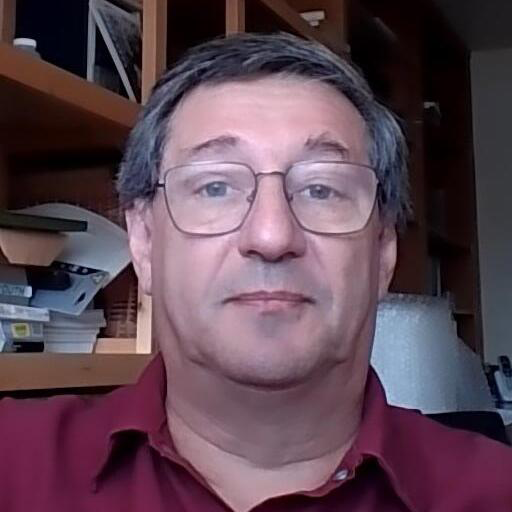
The prize citation for Dr. Givental’s Barry Prize reads:
By creating methods that connect symplectic geometry, algebraic geometry, singularity theory,
and mathematical physics, Alexander Givental has improved our ability to solve problems
across numerous areas of modern mathematics. He provided the first proof of Maxim
Kontsevich’s conjecture of mirror symmetry among Calabi-Yau manifolds, and has also
contributed to the defense of high standards in math curricula. The Academy honors Dr.
Givental’s distinguished contributions to humanity’s knowledge of mathematics, and
commitment to excellence in math education.
Alexander B. Givental is professor in the department of mathematics at the University of California-Berkeley. He is the author of several textbooks, including Linear Algebra (Sumizdat, 2022) and Introduction to Quantum Mechanics (Sumizdat, 2019) and has translated two volumes of Kiselev’s Geometry into English from the Russian original. His research interests center on symplectic and contact geometry, singularity theory, and mathematical physics.
November 2026
The prize citation for Dr. Givental’s Barry Prize reads:
By creating methods that connect symplectic geometry, algebraic geometry, singularity theory,
and mathematical physics, Alexander Givental has improved our ability to solve problems
across numerous areas of modern mathematics. He provided the first proof of Maxim
Kontsevich’s conjecture of mirror symmetry among Calabi-Yau manifolds, and has also
contributed to the defense of high standards in math curricula. The Academy honors Dr.
Givental’s distinguished contributions to humanity’s knowledge of mathematics, and
commitment to excellence in math education.
Alexander B. Givental is professor in the department of mathematics at the University of California-Berkeley. He is the author of several textbooks, including Linear Algebra (Sumizdat, 2022) and Introduction to Quantum Mechanics (Sumizdat, 2019) and has translated two volumes of Kiselev’s Geometry into English from the Russian original. His research interests center on symplectic and contact geometry, singularity theory, and mathematical physics.
November 2026