
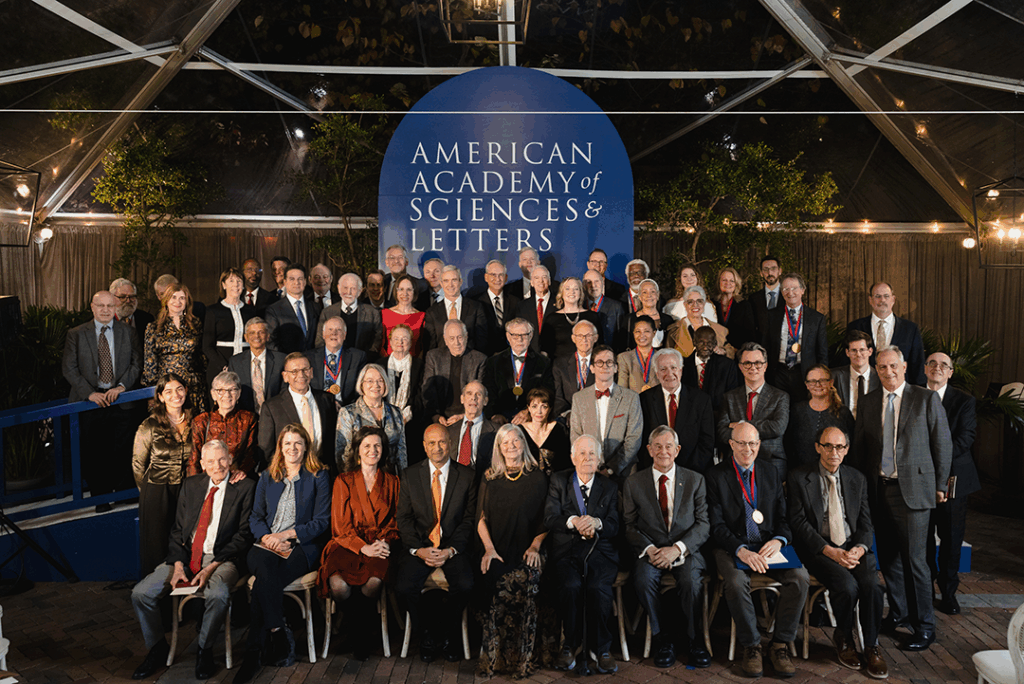
The following remarks were given by Dr. Donald Landry, MD, PhD, President of the American Academy of Sciences and Letters, at the Academy’s 2024 Investiture held at Decatur House in Washington, D.C. on Wednesday, November 12, 2025.
The most ancient schools of thought date back several millennia. Concepts of knowing, reflections on accumulating knowledge, the possibility of wisdom, these and many other preoccupations of prior ages all reflect the deeply-seated human yearning to understand.
The university, as a center of scholarly learning and teaching, began to emerge in Europe almost a thousand years ago. The modern university broadens its truth-driven mission, based on education and research, to include service to the public good. At its best, the modern university reflects and embodies the truth-seeking spirit of humanity at our best.
How is such a university characterized?
Robust academic freedom for faculty to identify and develop their areas and topics for investigation.
Uncompromised academic excellence as we grope towards truth, recognizing that our grasp on any particular truth is always provisional, subject to disconfirming data and contradicting insights.
Academic freedom of expression, so important we identify it as a right – a right to disseminate freely new disconfirming data and contradicting insights in that contest of ideas that is essential for truth seeking.
The unfettered right to teach and to learn, without which we have no university.
And finally, institutional neutrality, under which university leadership at all levels speaks out only on issues of central importance to the mission of the university, so that all faculty and students are equal participants in the university’s discussions and debates, not just those aligned with leadership.
To hold all these commitments together requires that the university navigate tensions. Protections for robust expression of unpopular ideas must be combined with reasonable time, place, and manner restrictions – restrictions that safeguard the right of others to teach and to learn unburdened by the biases of leadership.
Safety and order as well as intellectual freedom and debate must all be maintained; violence, intimidation, disruption, and all unlawful incivility must be excluded.
Within this framework, universities at their best advance teaching and learning, scholarship and research, and service, and are among the brightest gems of our civilization, truly representing us at our best.
The daring enterprise of a civil community that genuinely seeks the truth has been challenged in recent years, and at some institutions more than others. An argument can be made that the land grant universities, particularly those still faithful to the land-grant ethos of service to the public good, have flourished even in difficult years.
I would argue that this flourishing is exemplified by the University of Florida’s commitment to truth seeking and service. Our College of Agriculture has an Institute of Food and Agricultural Sciences with active operations in all sixty-seven counties of the state, and our College of Medicine has a university-owned hospital system strongly bonded to the underserved – both powerhouses of teaching, learning, scholarship, research, and service. Add to that the fourteen other colleges covering the expanse of human endeavor and the burgeoning Hamilton School for Classical and Civic Education, and we begin to see how a truth-seeking culture of academic excellence and free expression, civility, and service to the public good can be leveraged to the benefit of all.
Of course, public service favors practical knowledge, and we honor the diligent pursuit of practical knowledge across the academic disciplines. Yet, we also treasure knowledge for its own sake. Understanding our world more fully is inherently satisfying and enriching for us.
To understand ourselves, to understand ever more fully what it means to be human – this is the pinnacle toward which we climb.
The resolute pursuit of truth is not for the faint of heart. On the contrary, it requires bold questioning and fearless inquiry. It requires independence of mind. It requires intellectual courage.
How can this be encouraged?
Learned academies, like this one, first emerged in Europe in the 15th century. On this continent they predate the founding of the United States.
Such academies are created to respond to the circumstances of their times and places. But they are shaped by a continuing mission: to recognize and honor, to encourage and support, the search for truth, and to uphold and defend the freedoms of thought and inquiry that are always necessary for that search.
The American Academy of Sciences and Letters, like all learned academies, was founded to honor distinguished scholarly achievement across the disciplines of the university and thereby promote scholarship and learning.
Hence our motto: E Tenebris ad Lucem.
“From darkness into light.”
However, responding to the conditions of our own place, and the challenges of our own time, this Academy places a special accent on reaffirming the culture of academic excellence and on lifting up for the highest recognition eminent scholars whose exceptional achievements are the fruit of their independent and courageous cast of mind.
Members of the American Academy of Sciences and Letters are scholars who have made extraordinary contributions in the humanities, social sciences, natural sciences, mathematics, engineering, the arts, and the learned professions. Tonight, we will invest a total of sixty new members into the Academy, including – in a little while – the ten recipients of this year’s Barry Prize, the Academy’s highest honor.
The remarkable achievements of the sixty scholars we are investing tonight are an inspiration to us. They include an Ivy League university president, a Nobel laureate, a MacArthur fellow, a Turing award winner, and recipients of prestigious prizes from across the spectrum of academic disciplines.
Their accomplishments range from the design of new molecules capable of new kinds of catalysis, and unlocking secrets of distant planets and stars, to the invention of new methods for measuring human social behavior, and the renewed illumination of ancient ideas ranging from the classical Mediterranean and the Islamic world to the history of the university itself.
——
Each year, the Academy confers upon a person whose outstanding achievements demonstrate exemplary intellectual courage the Robert J. Zimmer Medal for Intellectual Freedom.
This Medal recognizes the work and profound witness of the late Robert Zimmer, who served from 2006 to 2021 as president of the University of Chicago. President Zimmer was an acclaimed mathematician whose commitment to intellectual excellence and academic freedom became the stuff of legend.
It was his inspired vision and leadership that bequeathed to the academic world the Chicago Principles of academic freedom, principles that he went on to apply courageously and even-handedly as university president. The Chicago Principles have been adopted by some 114 colleges and universities, ranging from Princeton University to the University of Virginia to Amherst College. They represent the gold standard for freedom of thought, inquiry, and discussion for the academic world.
President Zimmer passed away in 2023, a terrible loss for his family, his university, and for all who labor in the vineyard of higher education. On behalf of the board of the American Academy of Sciences and Letters, I approached President Zimmer’s widow, Professor Shadi Bartsch, and related how deeply we revere him for his visionary support of academic freedom and integrity, and how we sought through the Zimmer Medal to honor President Zimmer – with her permission – in order that his memory and contributions might endure.
She responded: “Bob would have been delighted and I am too. I hope that the Robert J. Zimmer Medal for Intellectual Freedom will be a beacon for many as we go forward, as Bob was himself.”
This is our shared hope. And I am delighted that, as she has in previous years, Professor Shadi Bartsch has once again joined us tonight to award the medal.
Thank you, Shadi, for the honor of your presence.
Each year, as we prepare to award the Zimmer Medal, we ask ourselves: Who could merit such an award for extraordinary courage in the exercise of intellectual freedom?
The board of the Academy unanimously chose to confer the 2023 Zimmer Medal on Sir Salman Rushdie, the globally famed novelist who has endured decades of threats and attacks for freely expressing his ideas with determined resolve.
Last year, the board of the Academy unanimously conferred the Zimmer Medal on Dr. Jay Bhattacharya, an epidemiologist who endured extensive public abuse, and serious threats to his professional work from both civil and university officials, in order to uphold the public’s right to free and open discussion of scientific findings on matters of urgent public concern.
This year, the Academy board has unanimously chosen to confer the Zimmer medal upon Dr. Paul McHugh of Johns Hopkins University.
For over fifty years, Dr. McHugh has been at the forefront of psychiatric theory and practice. In 1975 he co-published a mental state exam that remains one of the most widely used diagnostic tools in the field of mental health. He was chair of psychiatry at Johns Hopkins University from 1975 to 2001, where his research on the neuroscientific foundations of motivated behaviors, psychiatric genetics, epidemiology, and neuropsychiatry undergirded one of the most widely influential schools of thought in his field.
His honors are too numerous to recount, but I will mention that I was honored to serve with Dr. McHugh on the President’s Council on Bioethics, where Dr. McHugh served from 2002 to 2009. My recollections and impressions of him over my comparatively short term on the council are captured in the word, “sage.”
The Robert J. Zimmer Medal for Intellectual Freedom exists to uphold the highest standard of integrity in humanity’s pursuit of knowledge by honoring those who demonstrate extraordinary courage in the exercise of intellectual freedom. From his earliest work to today, on issues ranging from repressed memory to human sexuality to human cloning, Dr. McHugh has inflexibly resisted intense pressures from both the public and his own profession to compromise scientific standards of evidence and analysis. Time and again, he has stood out as a model of scholarly integrity, owing to his courageous choice to follow the evidence wherever it leads, analyzing it with dispassionate rigor.
One thing that has particularly stood out to me is Dr. McHugh’s relentless focus on patient outcomes. He has resisted the pressure of popular passions, not in obedience to any ideology, but from a genuinely open-minded scientific search to find out which treatments are shown to serve his patients best. He loves his patients and he knows well that he is helping no one if he is not telling them the truth.
Dr. McHugh’s example, like that of Sir Salman and Dr. Bhattacharya, reminds us that the only thing more costly than standing up for intellectual freedom would be failing to make that stand.